IPL 2026 Final Match Prediction: RCB vs GT — Lotus 365 Expert Analysis
The Indian Premier League’s grandest stage is set. On Sunday, May 31, 2026, defending champions Royal Challengers Bengaluru (RCB) will face Gujarat Titans (GT) in the IPL 2026 Final at the Narendra Modi Stadium in Ahmedabad. For Lotus 365 followers and cricket analytics enthusiasts alike, this is the matchup that the entire season has been building toward — a rematch of Qualifier 1 played under entirely different conditions, with enormous stakes on both sides.
RCB arrive as the tournament’s most dominant team and the first side to qualify for the final. Gujarat enter with extraordinary momentum, having pulled off what is now the highest successful chase in IPL history just two days ago. One team has the psychological advantage of a crushing win. The other carries the burning fuel of redemption.
Our Lotus 365 prediction: this will be an intensely competitive final. But on current form, venue dynamics, and the pressure of defending a title, RCB hold a meaningful edge.
Table of Contents
Match Overview
The IPL 2026 Final is more than a title match — it is a clash of contrasting cricket philosophies. RCB, led by Rajat Patidar, represent the league’s most structured batting unit, built around Virat Kohli’s consistency at the top and depth down to Tim David and Jitesh Sharma. Gujarat Titans, under Shubman Gill’s instinctive leadership, bring raw explosiveness, elite spin in Rashid Khan, and the most dangerous new-ball pairing in the competition.
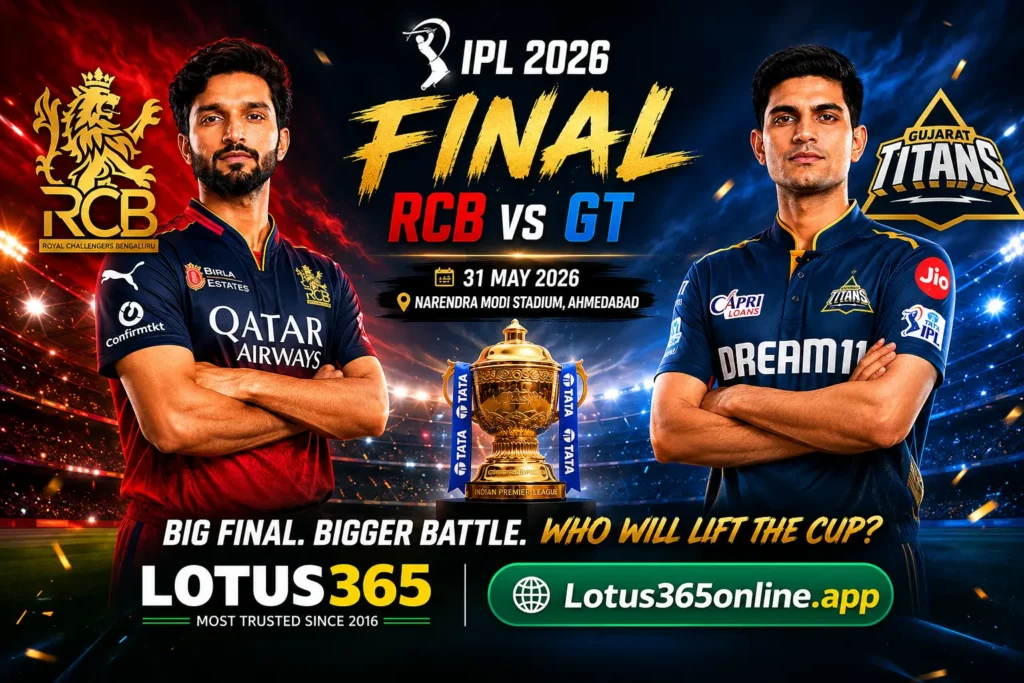
For RCB, winning back-to-back titles would put them alongside Chennai Super Kings and Mumbai Indians as the only franchises to successfully defend an IPL crown. For GT, lifting the trophy would make them just the fourth franchise in IPL history to win the title more than once, following CSK, MI, and KKR.
This is also a rematch with compelling subplots. Mohammed Siraj, who left RCB and is now GT’s most threatening pacer against his former side, gets another crack at the team that gave him his start. Jacob Duffy, the New Zealand quick who starred in Qualifier 1 for RCB with 3/39, could be the difference-maker again. And then there is Rashid Khan — world cricket’s finest T20 leg-spinner — who has yet to land a decisive blow in this season’s two encounters.
Match Timing and Venue Details
- Date: Sunday, May 31, 2026
- Toss: 7:00 PM IST
- Match Start: 7:30 PM IST
- Venue: Narendra Modi Stadium, Ahmedabad, Gujarat
- Capacity: 132,000 (world’s largest cricket stadium)
The venue shift is itself a talking point. The final was originally scheduled at M. Chinnaswamy Stadium in Bengaluru — RCB’s spiritual home — but was moved to Ahmedabad after BCCI cited issues with local association requirements. That decision effectively converts GT’s home ground into the final’s battleground, handing Shubman Gill’s side a significant crowd advantage in what could already be a psychologically charged evening.
Gujarat Titans: Recent Form
Gujarat Titans enter the final on the back of one of the most stunning comebacks in IPL playoff history. Their five-match form heading into the final is as follows:
- Win vs CSK (league stage) — 89-run demolition, GT batting and bowling at full strength
- Win vs SRH (league stage) — clinical chase, Rashid Khan instrumental
- Loss vs RCB (Qualifier 1) — 92-run defeat in Dharamsala, batting collapsed under scoreboard pressure
- Win vs RR (Qualifier 2) — chased 215 in 18.4 overs, Gill’s 104 off 53 balls
GT’s form across the league stage was exceptional. They won nine of 14 matches and consistently showed the ability to bat deep and bowl with variety. Their concern is singular but significant: the Qualifier 1 collapse against RCB revealed a fragility under extreme scoreboard pressure. When chasing 255 in Dharamsala, GT’s batting fell apart after the powerplay.
The Qualifier 2 performance, however, immediately rebutted that concern. Chasing 215 at Mullanpur against a quality RR attack — with Jofra Archer, Nandre Burger, and Brijesh Sharma all operating — Gill and Sai Sudharsan dismantled the target with contemptuous ease. That chase is now the highest in IPL playoff history, and it went to just 18.4 overs.
Batting trends: GT’s top three — Sai Sudharsan, Shubman Gill (C), and Jos Buttler — are among the most productive openers and No. 3s in the tournament. Washington Sundar’s promotion to No. 4 gives them an additional layer of middle-order stability. Rahul Tewatia and Jason Holder provide lower-order firepower.
Bowling trends: Kagiso Rabada and Mohammed Siraj are GT’s new-ball pillars. Bhuvneshwar Kumar (RCB) and Rabada are the tournament’s joint top wicket-takers entering the final. Siraj, bowling with extra edge against RCB, has 8 wickets in this rivalry overall and is their most dangerous weapon against familiar opponents. Rashid Khan has 14+ wickets this season with a strike rate of 14.5 — devastating figures in any format.
RCB: Recent Form
Royal Challengers Bengaluru topped IPL 2026’s league standings with 18 points and a net run rate of +0.783, winning nine of 14 games. Their recent form heading into the final:
- Win vs MI (league stage) — disciplined performance, bowling unit shone
- Win vs KKR (league stage) — Kohli anchored the chase with a half-century
- Win vs PBKS (league stage) — Hazlewood’s four-wicket haul won the match
- Win vs SRH (league stage) — Bhuvneshwar Kumar led the bowling
- Win vs GT (Qualifier 1) — record 254/5 and 92-run rout, Patidar’s 93* off 33 balls
RCB’s batting machinery has fired in clusters all season, but Qualifier 1 was the performance that distilled everything compelling about this side into one match. A 76-run powerplay, Kohli and Padikkal providing tempo before GT clawed back, and then Patidar detonating the final six overs with one of the most explosive IPL innings of 2026 — 93 off just 33 deliveries, with six not given out in those final overs due to Khejroliya’s costly no-balls.
Bowling trends: Bhuvneshwar Kumar is the tournament’s leading wicket-taker (or joint), bowling 16 death overs this season compared to just 6 for Rabada — a remarkable workload executed with consistency. Josh Hazlewood and Romario Shepherd provide the pace depth. Krunal Pandya’s slow left-arm has been the glue of RCB’s middle-overs attack. Jacob Duffy, a late addition to the attack, has proven impactful in high-pressure situations.
How Both Teams Reached the Final
Gujarat Titans Road to the Final
GT’s league stage campaign was built on a blend of power at the top and intelligence in the bowling — nine wins from 14 games put them squarely in the playoffs. Their only real wobble was the heavy Qualifier 1 defeat in Dharamsala, where they were simply overwhelmed.
Qualifier 2 in Mullanpur was a different story entirely. Rajasthan Royals posted 214/6, powered by Vaibhav Sooryavanshi’s 96 off 47 balls — the teenager who set IPL 2026 ablaze with 776 runs across the tournament at a strike rate of 237.3. It was a total that would have intimidated most teams. GT responded with ruthless intent. Sai Sudharsan struck 58 off 32 balls, Washington Sundar contributed briskly, and Shubman Gill simply took the match on — his fifth IPL century, off just 47 balls. GT reached 219/3 with 8 balls to spare.
RCB Road to the Final
RCB’s league-stage dominance was defined by their top-order depth and Bhuvneshwar Kumar’s leadership with the ball. They topped the table and entered the playoffs as clear favorites, which they duly justified. In Qualifier 1, Rajat Patidar’s unbeaten 93 off 33 balls in the final overs, following foundations laid by Kohli (43 off 25) and Krunal Pandya (43 off 28), propelled RCB to a tournament-record 254/5. The chase never truly began — GT were bowled out for 162.
Key turning point: GT dropping Patidar twice in the 14th over. He was on 18 at the time. He scored 75 more runs off just 15 balls after those reprieves.
Head-to-Head Record
Overall, RCB lead GT 5-4 in their nine IPL meetings. This will be their 10th encounter.
Crucially, in all their previous meetings at the Narendra Modi Stadium in Ahmedabad, GT have a strong home record, and the venue acts as a leveller given the shift from Chinnaswamy. In IPL 2026 specifically, the teams have met twice — once in the league stage (GT won) and once in Qualifier 1 (RCB won by 92 runs). The aggregate points stand level at 1-1 this season, making Sunday’s final the deciding contest.
Key trend: In matches at the Narendra Modi Stadium, the chasing team has historically had an advantage when dew sets in during the second innings. This will be a significant tactical consideration.
Pitch Report
The Narendra Modi Stadium surface in IPL 2026 has evolved across the season. Early on, it was a high-scoring batter’s paradise with average first-innings totals near 195. As the season progressed and pitches aged, that number gradually dropped toward 165-175.
For the final, the pitch is expected to offer true bounce and consistent carry. The outfield is quick. Square boundaries at 61–72m are generous, demanding precise placement from batters. Pacers have accounted for approximately 67% of wickets at the venue, with spinners picking up the rest — a ratio that strongly benefits both teams’ bowling attacks.
The surface will be a new one prepared specifically for the final, meaning initial assistance for pace in the new-ball period is likely. Spinners, particularly leg-spinners on the black-soil sections, should find increasing purchase as the match progresses toward the 10th over.
Average first innings score (IPL 2026 at NMS): 180–190 Chasing record: Slight advantage, particularly in dew conditions Pace vs spin: Pace has the edge with the new ball; spin effective mid-innings
Weather Report
Ahmedabad in late May is one of cricket’s most challenging environments. Based on conditions at the Narendra Modi Stadium in recent evening matches this season:
- Temperature at match time: 30–33°C (dropping through the innings)
- Humidity: 35–45% (moderate, but enough to generate dew later in the evening)
- Rain probability: Less than 5% — no concern for match interruption
- Wind: Light westerly breeze, 8–11 km/h
- Dew: Likely to settle from the 15th over of the second innings onward, assisting the chasing team’s batters and making the ball difficult to grip for spinners
The dew factor is perhaps the most important contextual element heading into the toss. At this venue and time of year, dew typically begins to form after the halfway stage of the second innings. Captains have consistently preferred to chase at the Narendra Modi Stadium in evening matches throughout IPL 2026 for precisely this reason.
Toss Prediction: Lotus 365 Analysis
Both captains will be acutely aware of the dew dynamics. At Narendra Modi Stadium across IPL 2026’s evening fixtures, the toss-winning captain has consistently elected to field first.
Predicted toss decision: Bowl first
The chasing advantage is real and measurable at this venue. Spinners become progressively less effective in dewy conditions, which disadvantages GT’s most potent weapon — Rashid Khan — if they field second. Conversely, it reduces RCB’s reliance on Krunal Pandya in the powerplay-to-middle transition. Both captains understand this equation. Whoever wins the toss will almost certainly put the opposition in.
Lotus 365 analysis suggests GT winning the toss and bowling first would hand them a slight structural advantage given the dew factor. RCB winning the toss and batting first would suit their batting depth but expose them to the classic “flat track in the chase” scenario.
Probable Playing XI
Gujarat Titans Probable XI
- B Sai Sudharsan
- Shubman Gill (C)
- Jos Buttler (WK)
- Washington Sundar
- Jason Holder
- Shahrukh Khan / Nishant Sindhu
- Rahul Tewatia
- Rashid Khan
- Kagiso Rabada
- Mohammed Siraj
- Prasidh Krishna / Manav Suthar
Impact Player options: Glenn Phillips, R Sai Kishore
RCB Probable XI
- Phil Salt (WK)
- Virat Kohli
- Devdutt Padikkal
- Rajat Patidar (C)
- Krunal Pandya
- Tim David
- Jacob Bethell / Venkatesh Iyer
- Romario Shepherd
- Bhuvneshwar Kumar
- Josh Hazlewood
- Jacob Duffy / Rasikh Salam Dar
Impact Player options: Jitesh Sharma, Suyash Sharma
Key Player Battles
Virat Kohli vs Kagiso Rabada
This is the powerplay contest that could define the final. Kohli leads all batters in runs against GT across their IPL rivalry. Rabada dismissed Kohli cheaply in GT’s league-stage win earlier this season. In Qualifier 1, Kohli weathered the Rabada challenge and made 43 off 25 before departing to Holder. In the final, Rabada will look to end Kohli’s innings early with his 146 km/h, seam-away delivery. Kohli, operating at the top of his powers in 2026, will target Rabada’s full-length balls through the off side. Three balls could decide this rivalry.
Shubman Gill vs Josh Hazlewood
Gill’s imperious Qualifier 2 form makes him the most dangerous batter in this final. Hazlewood’s ability to hit the hard lengths with relentless accuracy is RCB’s counter. This is a battle of two international-class performers who have faced each other frequently. Hazlewood’s record against right-handed top-order batters in this tournament has been exceptional. If he can unsettle Gill early, GT’s chase plans need a significant reconfiguration.
Rashid Khan vs Rajat Patidar
The biggest tactical duel. Patidar is one of the most destructive mid-innings batters in world T20 cricket. Rashid Khan has gone at a miserly strike rate of 14.5 wickets per spell this season. If Patidar is at the crease and the dew hasn’t formed yet, Rashid presents a genuine containment problem. Patidar’s ability to read leg-spin will be the central chess match of overs 7–13.
Bhuvneshwar Kumar vs Sai Sudharsan
Bhuvneshwar leads the tournament’s wicket charts and has historically had strong numbers against GT openers. Sudharsan’s technique against conventional swing is excellent, but Bhuvi’s subtlety — shape, slower ball, angled yorker — means the opening exchange could offer early advantages for RCB.
Batters to Watch
Gujarat Titans
Shubman Gill (C): He scored 104 off 53 balls in Qualifier 2 — a century to win a 215-run chase in a knockout match. Gill is in the form of his career and carries the emotional weight of GT’s campaign. In Ahmedabad, he will feed off the home crowd in ways that no other player in this lineup can. He has five IPL centuries to his name, and a final in Ahmedabad is the platform that could deliver a sixth.
B Sai Sudharsan: Consistent across the season, providing the steady axis around which Gill’s explosiveness operates. His 58 off 32 in Qualifier 2 was quietly decisive. Sudharsan rarely panics, and in knockout conditions, that temperament is invaluable.
RCB
Virat Kohli: The tournament’s most consistent performer across formats, Kohli has demonstrated against GT specifically that he can absorb pace and deliver tempo simultaneously. His 344 IPL runs across this rivalry across all editions is the highest by any individual batter between these two sides. Under lights at the NMS, expect him to be particularly dangerous in the powerplay.
Rajat Patidar (C): His Qualifier 1 innings of 93 off 33 balls is now part of playoff folklore. Patidar’s reading of match situations — when to anchor, when to accelerate — sets him apart from pure hitters. Two dropped catches off Prasidh Krishna cost GT dearly. They cannot afford similar lapses in the final.
Bowlers to Watch
Gujarat Titans
Kagiso Rabada: The new-ball threat every opposition fears. He has deployed himself primarily in the powerplay (three overs in the first six) and has been GT’s most consistent wicket-taker against top-order batters this season. His competition with Bhuvneshwar for the purple cap will be a stat line to track throughout the evening.
Rashid Khan: The world’s finest T20 leg-spinner has 14+ wickets this season at a phenomenal strike rate. In the Narendra Modi Stadium, black-soil sections can offer him grip and variable bounce. If the final goes deep and RCB are chasing, a dry first innings pitch could make Rashid almost unplayable between overs 8 and 16.
Mohammed Siraj: Bowling against his former franchise brings extra edge. Siraj has 8 wickets in this RCB vs GT rivalry overall. In Qualifier 1, he took 5 runs off 13 balls before being dismissed — but with the ball, he was testing and accurate. For the final, he is GT’s most dangerous weapon when pitch and conditions align.
RCB
Bhuvneshwar Kumar: The tournament’s leading pace wicket-taker. His range — swing with the new ball, slower cutters through the middle, precise yorkers at the death — represents the most complete bowling skillset in this final. Against Gill and Sudharsan specifically, his line through middle-and-off is an immovable challenge.
Josh Hazlewood: The Australian carries experience from World Cup knockout cricket that no other RCB bowler matches. At his best, Hazlewood delivers the pressure ball precisely when RCB need it most. He is the enforcer — accurate at 140+, capable of generating genuine bounce at this venue.
Jacob Duffy: The X-factor. His 3/39 in Qualifier 1 disrupted GT’s powerplay chase fundamentally. GT have limited data on him, which in a final is a considerable advantage.
Captain Comparison
Rajat Patidar (RCB): Led RCB to consecutive IPL finals and won the 2025 title. His captaincy is defined by clarity under pressure — smart bowling rotations, proactive field placements, and a willingness to promote the right batter at the right moment. In knockout matches specifically, Patidar has won three consecutive games as captain.
Shubman Gill (GT): A naturally aggressive leader whose batting form directly feeds his tactical confidence. Gill’s read of powerplay bowling is shrewd, and he has a strong record in knockout situations in IPL’s recent history. His weakness is a tendency toward conservative bowling changes during the middle overs when scoring rates drop.
Verdict: Patidar’s knockout record gives him a slight tactical edge, but Gill’s batting match-impact can override captaincy differentials.
Powerplay Analysis
RCB’s powerplay batting is the strongest single phase of play in this final. Phil Salt and Virat Kohli can give RCB 70–80 in the first six overs against any attack. In Qualifier 1, they posted 76/1 inside the powerplay. Against GT’s new-ball pair of Rabada and Siraj, this will be a fierce contest.
GT’s powerplay bowling — three overs from Rabada plus two from Siraj — is the best new-ball combination in this tournament. If they can restrict RCB to 60 or fewer in the powerplay with two wickets, the match changes dramatically.
GT’s powerplay batting — Sudharsan and Gill — is equally dangerous. In the Qualifier 2 chase, they made 90+ inside the powerplay. Bhuvneshwar and Hazlewood will target the corridor outside off stump. If GT’s openers go at 10+ per over in the powerplay, no chase is beyond them at this stadium.
Expected powerplay scores: RCB batting first — 68–80. GT batting first — 55–70.
Middle Overs Analysis (Overs 7–15)
This is where Rashid Khan can dominate. In dry conditions, he can slow RCB’s acceleration significantly and create wicket opportunities in the 8th–14th overs. RCB’s counter is Krunal Pandya, who has shown the ability to reverse-sweep and hit against the turn.
If GT bat first, Washington Sundar provides batting stability while his off-spin also contributes to the bowling rotation. RCB will target Sundar — he has gone for more runs than GT would like in middle-over batting situations.
Death Overs Prediction (Overs 16–20)
RCB’s death bowling — Bhuvneshwar (4 overs to the powerplay and death), Hazlewood, and Romario Shepherd — is RCB’s second-greatest advantage after their batting depth. Bhuvneshwar specifically has bowled 16 death overs this season with remarkable control.
GT’s death batting — Rahul Tewatia, Jason Holder, and Shahrukh Khan — is experienced. Tewatia’s record in pressure moments is exceptional. However, against Bhuvneshwar’s death bowling specifically, GT’s lower order has historically struggled to find the boundary.
RCB’s death batting — Tim David and Jitesh Sharma — can post 40+ in the final four overs. Tim David has an elite T20 record in death-overs hitting globally. This is RCB’s finisher advantage.
Tactical Analysis
RCB’s plan if bowling first: Control the powerplay with Hazlewood and Bhuvneshwar, slow Gill’s acceleration with tight lines through off stump, use Krunal Pandya to create pressure on Buttler and Washington Sundar through overs 7–12, attack with Hazlewood in the 15th–16th overs when the pitch is at its most responsive.
GT’s plan if bowling first: Use Siraj and Rabada to attack Salt and Kohli’s outside edge in the powerplay, bring Rashid Khan on early (over 7 or 8) to create wicket opportunities in the middle, contain Patidar with Jason Holder’s short-pitched tactics, close with Siraj’s yorkers at the death.
Momentum Analysis
GT arrive with extraordinary momentum from the Qualifier 2 masterclass. Shubman Gill’s century in a 215-run chase is the kind of performance that fills a dressing room with belief for weeks. The home crowd factor — 132,000 fans, most of them cheering for GT — will generate the loudest atmosphere of the season.
RCB, meanwhile, have had a four-day break since Qualifier 1 — a double-edged advantage. Fresh legs benefit a physical side, but the absence of competitive cricket can disrupt rhythm. Their 92-run win over these exact opponents in the same playoff round is both a confidence-builder and a source of complacency risk.
Psychological edge: GT, marginally. Gill’s century gives them the last major performance. But RCB’s title-defending identity is a counter-pressure of its own.
Pressure Handling Analysis
RCB have now been to five IPL finals in their history and won the most recent one. Patidar’s squad carries title-winning DNA from 2025, and several players — Kohli, Bhuvneshwar Kumar, Hazlewood — have deep international knockout experience.
GT have been in three IPL finals (2022 win, 2023 loss, and now 2026). Shubman Gill has personal experience of scoring at the highest level in knockout situations. However, their Qualifier 1 collapse at 162 all out chasing 255 showed they can fold under extreme scoreboard pressure — a vulnerability RCB will aim to recreate by posting a dominant first-innings total.
Team Strengths and Weaknesses
Gujarat Titans
Strengths:
- Exceptional batting firepower at the top three positions — Sudharsan, Gill, Buttler combined are the most productive top order in this final
- Rashid Khan’s unique wicket-taking ability, unmatched in T20 cricket
- New-ball combination of Rabada and Siraj — both world-class and in form
- Home ground advantage in Ahmedabad, with a 132,000-strong partisan crowd
- Momentum and psychological lift from the Qualifier 2 century by Gill
Weaknesses:
- Middle-order fragility under heavy scoreboard pressure (evidenced in Qualifier 1)
- Dew disadvantage when bowling second — Rashid Khan loses grip and wicket-taking ability significantly in dewy conditions
- Limited alternative spin options if Rashid goes for runs
- Relatively inexperienced final-match tactical record outside of their 2022 title win
RCB
Strengths:
- Deepest batting order in the final — from Salt/Kohli all the way to Bhuvneshwar, every position can score
- Tournament’s leading pace wicket-taker in Bhuvneshwar Kumar
- Proven knockout performer in Rajat Patidar as both captain and batter
- Virat Kohli’s specific record against GT is the best of any individual batter in this fixture
- Greater experience of final-match conditions as defending champions
Weaknesses:
- Phil Salt’s consistency at the top is slightly less reliable than Kohli’s — a fast early dismissal could shift momentum
- Middle-overs spin attack is limited; Krunal Pandya’s effectiveness will be heavily targeted
- Away conditions in GT’s home stadium with a largely hostile crowd
- Four-day break may slightly disrupt the momentum rhythm built in Qualifier 1
Fantasy Cricket Insights
Safe Captain Choices: Virat Kohli (consistent, strong record vs GT, high floor), Shubman Gill (century in Qualifier 2, playing at home)
Safe Vice-Captain Choices: Rajat Patidar (proven knockout performer), Kagiso Rabada (leading pace wicket-taker entering final), Bhuvneshwar Kumar (most wickets in IPL 2026)
Differential Picks: Jacob Duffy (low ownership, high impact in Qualifier 1 — 3/39), Washington Sundar (useful batting runs plus bowling economy)
High-Risk Picks: Phil Salt (can score 50+ or zero in the powerplay), Rahul Tewatia (match-defining lower order impact potential)
Small League Picks: Bhuvneshwar Kumar (C), Virat Kohli (VC)
Grand League Picks: Jacob Duffy (C) — if RCB bowl well early, he could be the deciding bowler; Rajat Patidar (C) — repeat knockout performance is entirely within range
For comprehensive fantasy and predictions, Lotus 365 offers real-time match insights and analytics viaLotus365 App Download, making pre-match fantasy decisions significantly more informed. Regular users of Lotus365 Login will find specific Lotus 365 tournament analysis sections updated ahead of the final.
High-Risk and Safe Prediction Factors
Safe Factors:
- Dew will play a role in the second innings — confirmed historical trend for Ahmedabad evening matches
- Bhuvneshwar Kumar will take at least one wicket — done in 11 of his last 12 IPL matches
- Shubman Gill will score 30+ — he has failed to reach 30 in only two of his last nine IPL innings
- Virat Kohli will open and provide a solid platform regardless of first-innings team total
High-Risk Factors:
- GT’s fielding can deteriorate sharply under pressure — two dropped catches in Qualifier 1 were match-defining
- RCB’s middle order without Patidar firing is susceptible — if he goes early for under 20, their total could stall
- Rashid Khan in dry conditions (if GT bowl second and dew hasn’t formed) could be unplayable
- The home crowd of 132,000 is an unpredictable factor; it can either intimidate RCB or inspire GT beyond their technical capacity
Session-Wise Prediction
Powerplay (Overs 1–6): Expected to be a high-intensity powerplay battle. If RCB bat, expect 68–78 with 1 wicket. If GT bat, expect 60–72 with 1 wicket. This phase will likely set the template for the match.
First 10 Overs: The team batting first should be at 95–115 at the halfway stage. A total below 95 at the 10-over mark signals major bowling dominance; above 115 signals a 190+ finish.
Middle Overs (Overs 11–15): Rashid Khan (if GT bowl) or Krunal Pandya (if RCB bowl) becomes the pivotal figure. This phase typically produces 45–60 runs and 1–2 wickets.
Death Overs (Overs 16–20): 55–70 runs expected. The team batting first should target 180+; the team chasing needs their finishers to be set by over 14.
Match-Winning Probability
RCB: 56% | GT: 44%
RCB hold the edge based on: superior finishing options (Tim David, Jitesh Sharma in the chase), Bhuvneshwar Kumar’s demonstrated ability to restrict GT, and Rajat Patidar’s exceptional knockout record. The defending champion’s identity and the psychological weight of back-to-back title defence are also underappreciated motivational factors.
GT’s 44% is not insignificant. A home crowd, Rashid Khan in favourable conditions, and Gill’s extraordinary form from Qualifier 2 give them a very realistic chance of stealing the title on a night where conditions align.
Predicted Score
Scenario 1 — GT Bat First: GT score 175–190, with Gill (50–70) and Sudharsan (35–50) providing the platform, Holder and Tewatia contributing 20+ each in the lower order. RCB, chasing under dew, are likely to chase it down in 18–19 overs.
Scenario 2 — RCB Bat First: RCB post 185–200, with Kohli (45–60), Patidar (50–70 from overs 14–20), and Tim David providing a death-overs flourish. GT, chasing without the dew benefit in the first innings, are restricted to 170–180 and fall short.
Predicted Top Scorer
Virat Kohli (RCB) — Kohli’s record against GT is exceptional, his current form is among his best in IPL 2026, and he plays at the top of the order where powerplay conditions typically favour him. If RCB bat first, expect a 50–65 under lights. If chasing, his anchor-and-accelerate game could be the decisive innings of the night.
Predicted Highest Wicket Taker
Bhuvneshwar Kumar (RCB) — The tournament’s joint leading wicket-taker enters the final as the most complete bowling performer in this fixture. His ability to operate across all three phases (new ball, middle, death) gives him the widest window to accumulate wickets. Expect 2–3 wickets and economy under 9.
Predicted Man of the Match
Rajat Patidar (RCB) — In knockout cricket across IPL 2026, Patidar has been the most impactful individual match performer. He has the ability to win a match almost single-handedly with the bat — as proven in Qualifier 1. With the captaincy decision-making and batting in the 13th–20th overs, Patidar is the likeliest candidate to define the final.
Final Winner Prediction: Royal Challengers Bengaluru
Why RCB Are More Likely to Win
Current form: RCB ended the league stage as the tournament’s top-ranked team and delivered a dominant 92-run playoff win over these exact opponents days ago. That is a difficult psychological mountain for GT to overcome.
Venue conditions: Despite GT’s home advantage in terms of crowd, the Narendra Modi Stadium’s evening dew characteristics actually benefit the chasing team — and RCB’s batting depth makes them the more dangerous chasing unit in the second innings.
Toss impact and dew factor: If RCB win the toss and bowl first, their bowling unit can restrict GT to a chaseable total and exploit dry conditions for Bhuvneshwar and Hazlewood. If they bat first, their finishing depth through Tim David and Jitesh Sharma can post a target that GT’s death batting cannot realistically chase without dew.
Batting depth: RCB can bat from positions 1 through 9 with genuine scoring capacity. Tim David and Jitesh Sharma batting at 6 and 7 is a luxury no other IPL 2026 finalist possesses.
Spin vs pace matchup: If the pitch plays true and the dew doesn’t arrive early, Rashid Khan could be the deciding factor. However, RCB’s anti-spin batters — Kohli, Patidar, Bethell — are more calibrated to handle leg-spin than GT’s middle order is to handle pace variation from Hazlewood and Bhuvneshwar.
Death bowling quality: Bhuvneshwar Kumar bowling 16 death overs this season compared to Rabada’s 6 tells you everything about who is the more complete death operator in this final.
Finishing ability: Tim David’s record in T20 finals globally, combined with Patidar’s extraordinary Qualifier 1 form, means RCB’s finishing is demonstrably superior.
Powerplay performance: RCB’s powerplay (76/1 in Qualifier 1) has been the strongest in the tournament. If they post that platform again, the total becomes difficult for any team to chase.
Middle-order stability: Krunal Pandya’s IPL final experience, combined with Jacob Bethell’s composure, gives RCB a steadier core than GT’s Washington Sundar / Shahrukh Khan combination under pressure.
Pressure handling: RCB have won the last three consecutive knockout matches in IPL 2026. That streak carries its own psychological inertia.
RCB to win the IPL 2026 Final and become back-to-back champions.
Conclusion
The IPL 2026 Final is a contest between two of the tournament’s best-designed teams, colliding in a rematch where the context has shifted entirely. RCB carry momentum, experience, and the weight of defending champions. GT carry Gill’s brilliance, Rashid’s genius, and the fire of a side that has just executed the highest successful chase in playoff cricket history.
The Lotus 365 final verdict acknowledges the unpredictability of a T20 final. Cricket has the capacity to flip on one over, one dropped catch, one yorker. But across all measurable metrics — form, depth, death-overs bowling, knockout record, and venue adaptability — RCB present a more complete picture. Rajat Patidar’s side deserve their status as slight favourites, and the expectation is that they will deliver.
For live odds, match analysis, and real-time updates on the IPL 2026 Final, Lotus 365 remains the destination of choice. Users can access the full platform via Lotus365 App Download and take advantage of pre-match Lotus365 Bonus offers that are available for IPL finals specifically. Those looking to register before the final can do so easily through lotus365 register — a process that takes less than two minutes. Lotus365 VIP members receive enhanced live cricket analysis and Lotus365 Win predictions updated ball-by-ball throughout the match.
Whether you access the platform via Lotus365 Login or explore the Lotus365 Blue interface on desktop, Lotus 365 delivers a premium cricket experience for the sport’s biggest occasions. And Sunday, May 31 in Ahmedabad is unquestionably the season’s biggest occasion. The Lotus365 Cricket Betting section provides professionally compiled odds for all major match markets.
Predicted Winner: Royal Challengers Bengaluru Predicted Score (RCB bat first): RCB 192/5 — GT 176/8
Frequently Asked Questions (FAQs)
Q1. Who is the favorite to win the RCB vs GT IPL 2026 Final?
Royal Challengers Bengaluru enter as slight favorites based on their league-stage dominance (18 points, top of the table), superior knockout record (three consecutive wins in IPL 2026’s playoff rounds), and the psychological advantage of a 92-run win over Gujarat in Qualifier 1. However, GT’s Qualifier 2 performance and home crowd in Ahmedabad make this a genuinely competitive final. Lotus 365 places RCB at a 56% win probability entering the match. GT carry Shubman Gill’s extraordinary form and home support as genuine equalizing factors. Neither side should be underestimated on the night.
Q2. What is the pitch report for the IPL 2026 Final at Narendra Modi Stadium?
The Narendra Modi Stadium in Ahmedabad offers a true-bouncing surface that has supported batters throughout IPL 2026, with average first-innings scores in evening fixtures falling between 175–195. Pacers account for approximately 67% of wickets, with spinners effective from the 8th over onward, particularly on the black-soil sections. Square boundaries (61–72m) are generous. A target of 180–190 is considered par, and the chasing team benefits from dew in the second innings. For the final, a fresh-prepared surface should offer early pace movement before settling into a batting-friendly surface by the middle overs.
Q3. Will dew affect the IPL 2026 Final in Ahmedabad?
Yes — dew is expected to be a significant factor, particularly from the 14th–15th over of the second innings onward. Ahmedabad evening conditions in late May consistently produce dew that settles on the outfield, making the ball difficult for spinners to grip. This is why both captains are expected to prefer chasing after winning the toss. Rashid Khan’s effectiveness is the biggest bowling variable — in dry conditions he is near-unplayable, but once dew forms, his wicket-taking becomes constrained. Bhuvneshwar Kumar, as a pace bowler, is relatively less affected.
Q4. Who can be the top scorer in the IPL 2026 Final?
Virat Kohli is the likeliest top-scorer candidate. His record against GT is the best of any individual batter in their head-to-head history, and he carries exceptional form into the final. Shubman Gill — fresh off a 104-ball century in Qualifier 2 — is the other leading candidate and arguably in the form of his career. Rajat Patidar’s unbeaten 93 in Qualifier 1 makes him a live dark-horse, particularly if RCB bat first and he bats through the death overs. Lotus 365 analysis points to Kohli as the most consistent scoring probability across all match scenarios.
Q5. Who can take the most wickets in the IPL 2026 Final?
Bhuvneshwar Kumar is the standout candidate. The tournament’s leading pace wicket-taker enters the final having delivered 2–3 wickets in the vast majority of his IPL 2026 appearances, with a range that covers all phases of the innings. Kagiso Rabada is the alternative — GT’s most dangerous wicket-taker, particularly in the powerplay. If conditions assist swing early, Rabada could be devastating. Jacob Duffy is the dark-horse pick — his Qualifier 1 display of 3/39 suggests he has the tools to disrupt GT again if utilized in similar phases.
Q6. What is the predicted score for the IPL 2026 Final?
If RCB bat first: RCB are expected to post 185–200, building on Kohli/Salt powerplay foundations before Patidar and Tim David accelerate in the final six overs. GT chasing under dew conditions should reach 170–182 but fall short. If GT bat first: a total of 175–190 is expected, with Gill and Sudharsan providing the platform. RCB, chasing under dew with Tim David and Patidar available, should overhaul the target in 18–19 overs. Overall predicted final margin: RCB by 10–15 runs or 2–3 wickets in the final over, making this the tight, dramatic finish that an IPL Final deserves.