How to Verify the Official Lotus 365 Website and Avoid Fake Domains
There are many fake websites that mimic the official Lotus365 website. These are “cloned” sites that are intended to trick you into providing your login information, personal information, and payment details. If you’re new to lotus 365 login or looking for the www lotus com login, you should always confirm you’re on the authentic site before logging in.
This Lotus365 login guide will help you recognise the official website, how to identify fake websites, safe downloads of Lotus365 apk and how to avoid phishing scams.
When visiting the official Lotus365 website, make sure to verify the website URL, check whether it is HTTPS with a valid SSL certificate, and only visit the login page through trusted sources. Avoid visiting shady sites and downloading lotus365 apk from unofficial sources.
Table of Contents
Why Fake Lotus365 Websites Exist
Fraudsters set up fake websites of “Lotus365” to trick users into giving their usernames, passwords, OTPs, banking information, and deposits away. Often these phishing sites mimic the look of the original site.
Fraudulent lotus365 pages, unofficial lotus apk downloads with malicious content, fake payment pages, and fake customer support messages requesting users to log-in via malicious links are typical scams.
Never log in without checking the domain and never click on links you don’t know in social media, messaging apps or ads. To log in and get some safety tips, you should read our Lotus365 Login Guide before logging in to your account.
How to Identify the Official Lotus365 Website
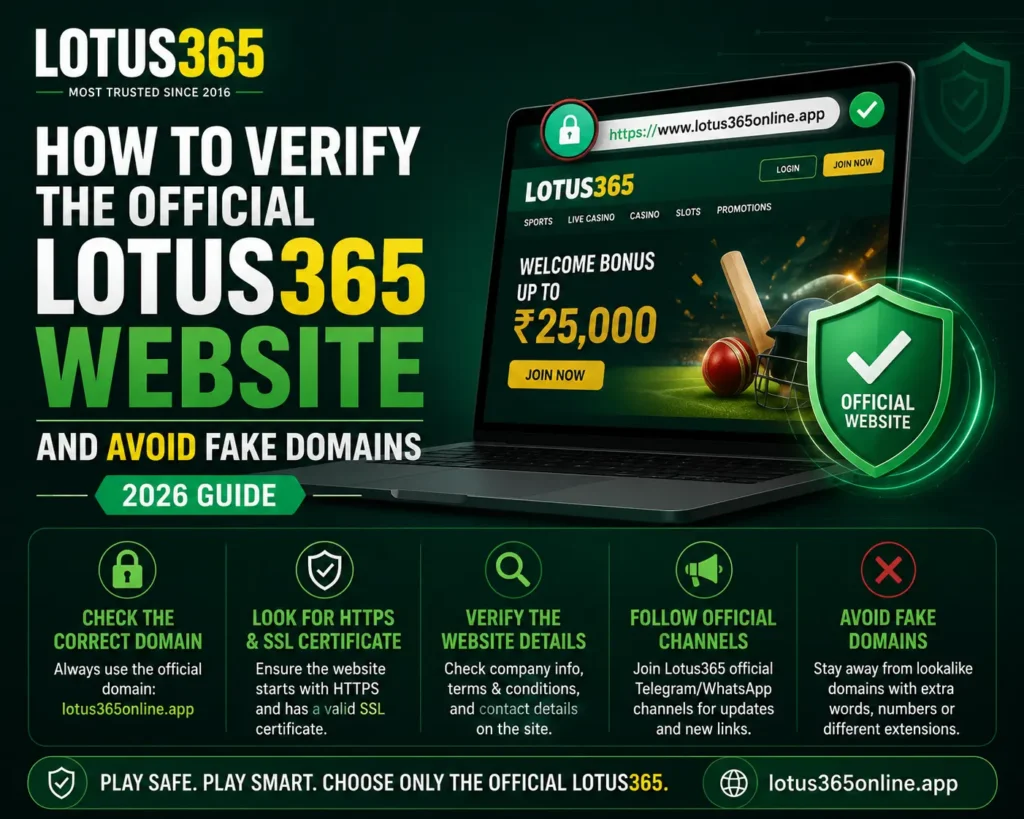
Before proceeding with the Lotus 365 login, please make sure that you are accessing the official Lotus365 website. There are a number of simple checks you can make to make sure your account is secure from phishing scams and fake domains.
Check the Domain Name Carefully
Make sure you enter the right website address before logging in.
Often scammers will use a similar domain with slight variations in spelling. Don’t assume that all the domains that are similar to www.lotus365.in, www.lotus365.win, or www.lotus365.com are legitimate. Only visit the official login page using trusted sources.
Confirm HTTPS Security
Check the website is secure (HTTPS) and has a padlock icon in your web browser. A secure connection protects your logon information, but it’s still important to check the domain. The user can check the SSL certificate.The user can verify the SSL certificate.
To check SSL certificate, click on the padlock icon. If you are warned of or see certificate problems or security errors in your browser, exit the page.
Verify Customer Support
Only trust confirmed Lotus365 Customer Care information. Avoid any random WhatsApp numbers or social media accounts that promise login assistance or special bonuses.
Use the Official Login Page
Access lotus 365 login always using the official login page, and not through links provided in message apps, emails, or ads. Do not use unknown websites for login problems, instead refer to the Lotus365 Login Guide or the Lotus365 Login Problems guide.
Download Lotus365 APK Safely
Only install the apk of lotus365 from trusted and verified sources. Unofficial APK files may carry malware which could lead to the acquisition of Passwords, banking information, or personal information. If you follow these simple checks, you will be able to recognize the actual Lotus365 site and not the phishing site, which will attempt to steal your account or financial details.
10 Signs You’re Using a Fake Lotus365 Website
Numerous fake gambling websites are set up to appear convincing. They replicate the logos, colors and layouts to give users the impression that they are on the authentic site. Most fake websites, however, give off some giveaways. It’s important to know how to identify these signs to prevent phishing attacks and to keep your account safe.
1. The Domain Name Looks Slightly Different
The first thing to check is the web site address. Some cybercriminals tend to register domains that look like the original brand, but are slightly altered with additional letters, numbers, punctuation, or unusual extensions.
These changes may not all be apparent on a quick glance.
One example of this is that a domain can change one letter for another one that looks alike in the URL, or add a new word to the URL. Never take for granted that all search results are legitimate, always check the address carefully. An extra few seconds spent verifying the URL will keep you from being directed to a fake Lotus365 site.
2. Too Many Advertisements and Pop-Ups
A genuine betting site is about user experience and NOT in-your-face advertising. If a site opens several pop-ups the moment you visit it, redirects you to promotional pages or keeps showing you a banner to click before you get to the sign-in page, it’s probably a scam.
Some websites even show ads for things that have no connection with sports betting, such as investing or downloading casino software or even mobile apps. A lot of advertising may be seen as a sign of the website’s focus on generating traffic rather than ensuring a safe service.
3. It Requests OTPs Without a Valid Reason
A valid login process will only request verification when it is warranted. Do not enter a one-time password before you log on to a site, if you are asked to enter several one-time passwords in succession, or if a site asks for banking verification codes that are not needed to protect your account.
Scammers often try to trick you into giving them your authentication codes so that they can gain access to your actual accounts. Keep in mind that no real support agent will request an OTP via a chat or message service.
4. Unrealistic Bonus Offers
Websites that offer rewards that are too good to be true are usually fraudulent websites.
Examples include:
- Guaranteed winnings
- The welcome bonuses are extremely high.
- Unlimited cash back and no conditions.
- Withdrawals can be made instantly even without verification.
- Free spins after any deposit!Free spins for life!
Anything that’s a legitimate promotion will have the terms and the rules spelled out. If the bonus seems too good to be true, check it on the official website before playing.
5. Spelling and Grammar Mistakes
Before entering a password, see if the connection is encrypted. The browser should show you HTTPS security and padlock. If the browser is alerting you that the connection is not secure, or if you see certificate errors, exit the browser immediately.
While HTTPS does not necessarily mean authenticity, it does mean that there is a greater risk of security issues if the connection is not secure.
6. The Website Is Not Secure
Before entering any password, check whether the connection is encrypted.
Your browser should display HTTPS security along with a valid padlock icon. If the browser warns that the connection isn’t secure or displays certificate errors, leave immediately.
Although HTTPS alone doesn’t guarantee authenticity, an unsecured connection significantly increases security risks.
7. The Design Feels Copied but Doesn’t Work Properly
A cloned site can look virtually identical to the legitimate website, and yet have non-working features.
Note the following problems:
- Buttons that do nothing
- Broken navigation menus
- Missing images
- Blank pages
- Slow-loading login forms
- Incorrect page redirects
Most often, these issues mean that only the website’s look has been duplicated, not the entire site.
8. Unusual Payment Requests
The first of the many red flags is the deposit.
A legitimate platform will typically have clear instructions for payment, which will be in the form of accepted payment methods.
Be cautious if you’re asked to:
- Make transfers to an individual bank account.
- Add funds to individual bank account.
- Send transactions without confirmations
- Make payments using unknown wallets.
- Make deposits using unofficial QR codes
- Don’t use payment links from strangers
Always verify payment instructions through official customer support before transferring funds.
9. Responsible Gaming Information Is Missing
A reliable betting website generally has pages dedicated to:
- Responsible gaming
- Privacy policy
- Terms and conditions
- Account security
- User policies
If these pages are not present, incomplete or from other websites, verify the authenticity of the site.
Responsible gaming information demonstrates transparency and shows that the operator values user protection.
10. Suspicious Redirects
A phishing website is usually cloaked in a redirection.A phishing web site frequently redirects the user unexpectedly.
For instance, when you click on the login button, it might redirect you to:
- A different domain
- An unused download page.
- A survey website
- Any payment gateway that is not recognized.
- Another cloned login screen
One of the better signs that you aren’t interacting with the proper site is when they redirect you unexpectedly.
If there is something that doesn’t feel right, close the browser window and use a trusted site to log in to the platform.
If you want to get a wider idea of the security of the platform, you can also go ahead and read the Lotus365 Safe & Legit Review where you will find information on what factors you must consider before you can trust any betting site.
Should You Trust Lotus365 APK Downloads from Third-Party Websites?
A lot of users want to download the app rather than use a browser. Unfortunately, this convenience has also opened up opportunities for scammers to create altered versions of the applications.
When you look for lotus365 apk, you will find a lot of unofficial lotus365 download sites. Some of these pages mimic the original branding, but instead of giving out the actual application, give out malicious content.
Why Fake APK Files Are Dangerous
There are a number of potential risks with modified APK files, particularly when compared to the official application sources, as they may contain malicious software that can harm the device.
Possible risks include:
- Used to modify system files causing damage.Malware which corrupts system files.
- Spyware that records personal information
- The keyloggers that log on to user names and passwords
- Software that steals OTP messages
- Computer systems that track the financial transactions.
Most users are unaware of any issues until unauthorized activity is seen in their accounts.
Fake Update Pages Can Be Convincing
A common tactic used by attackers is to build pages that purport to be about how your app is out-of-date.
These fake update screens will look like a warning message, for example:
- “Critical Security Update Required”
- “New Version Available”
- “This means the login is disabled until the account has been updated.”
Never automatically download an update, check whether the notification is from the official platform.
Verify the Download Source
Before installing any APK file there are a number of important considerations.
Confirm that:
- The link to download is provided from a official source.
- The website is secure with HTTPS.
- The branding matches the official platform.
- If in doubt, customer support will confirm the download page.
- The file hasn’t been shared through unknown messaging groups.
Do not install any applications from random Telegram channels or unofficial forums, unknown websites, or any fake WhatsApp agent claiming to provide a “special version.”
Scan Every Download
It is always best to use a reputable mobile security software to scan the file before installing, even if the file is downloaded from a trusted source.
Having an updated operating system and blocking unnecessary app permissions decreases security risks as well.
If you have already downloaded and installed an app from an unfamiliar website, remove it from your device, run a thorough security check, update passwords and check for suspicious activity in accounts recently accessed.
Not all download pages are verified – use the official Lotus365 APK Download to get step-by-step installation instructions or the complete Lotus365 App Download Guide.
How to Stay Safe Before Logging into Lotus365
There are some basic practices you can establish that will have a significant impact on your online safety. Prior to each logon, take a few minutes to verify the following:
Bookmark the Official Website
After you have established that you’ve located the right website, save it as a bookmark in your browser.
Bookmarks help prevent clicking on ads or links that may be misguiding or phishing links on search results pages.
Verify the URL Every Time
Just because you have a visit it doesn’t always mean you’ll get the right site.
Often attackers buy fake domains that can be used to deceive users who have visited previously. One of the easiest methods for increasing login security is to check the URL prior to logging in.
Check HTTPS Security
Make sure that the connection is always made using HTTPS.
Using an encrypted connection helps protect information that is passing from your browser to the server. If your browser issues security alerts, do not log in until you are sure that you are not being directed to a scam site.
Verify the SSL Certificate
Click the lock icon to view the website’s certificate. No certificate warnings, expired certificates or mismatching domain information should be overlooked or ignored.
A major component of domain verification, SSL verification is a straightforward yet effective method.
Enable Two-Factor Authentication
If possible, use 2-factor authentication to further secure your account. If your password is ever discovered, 2FA provides an extra layer of security to make unauthorized access more difficult.
How to setup this feature, you can refer to theLotus365 2FA Guide.
Avoid Public Wi-Fi
Public wireless networks found in airports, cafés, hotels, and shopping centers are generally less secure than trusted home or mobile networks.
Whenever possible, use your own internet connection when accessing betting accounts or making financial transactions.
Never Share OTPs
A support agent should never request a verification code.
Avoid sharing your OTP with anyone who asks for it via chat, phone calls, email or messaging services, unless you can independently verify their identity.
Use Strong, Unique Passwords
Create passwords that are difficult to guess and avoid reusing the same password across multiple websites.
A password manager can help generate and securely store complex passwords without requiring you to memorize them.
Regularly Review Account Activity
Check your login history, deposits, withdrawals, and betting records regularly.
If you notice unfamiliar devices, unexpected balance changes, or transactions you don’t recognize, take immediate action.
Additional practical advice is available in the Lotus365 ID Security Tips guide, which explains how to strengthen your overall account security and reduce the risk of unauthorized access.
What to Do If You Visited a Fake Website
If you realize that you’ve entered your data on a dubious site, it is stressful, however, if you act promptly, it is possible to minimize the danger of account compromise. Follow these steps as soon as you suspect you’ve visited a fake or phishing website.
Change Your Password Immediately
If you used the username and password on a non-official page, change your password as soon as possible on the official login page.
Choose a new password that is:
- Must contain at least 12 characters.Must be at least 12 characters in length.
- A combination of capital and lower case letters.
- Uses numbers and symbols
- Differing from passwords on other websites
For assistance with recovery of access, use the Lotus365 Lotus365 Password Reset Guide.
Contact Official Customer Support
Inform the official support team about the incident.
Explain:
- On the occasion of your visit to the suspicious website
- If you have entered your details into the computer system,
- If you made full payment or partial payment.
- Any unusual activity associated with your account that you see.
In addition, phishing reports help the site investigate and block phishing sites and warn other users.
Review Your Account Activity
Thoroughly check for any suspicious transactions.
Look for:
- Unknown login attempts
- Unexpected password changes
- What bets that you did not make?What wagers did you not place?
- How to deposit or withdraw money.Request for Deposit & Withdrawal.
- Changes to your personal information
Don’t hesitate to report any item if it seems unfamiliar.
Reset Credentials on Other Websites
If you used the same password on another services change those as well.
One of the most serious security threats is the re-use of passwords across many platforms as this is where attackers look to your stolen account.
Enable Two-Factor Authentication
If two-factor authentication has not been set up, do so now. Even if someone has your password, 2FA can help stop a hacker from logging in if they are trying to by asking for a second form of authentication when you log in.
Scan Your Device for Malware
Run a full system scan with trusted antivirus or mobile security software if you have downloaded anything from a suspicious website or installed an application which is not official.
Before accessing your betting account again, delete any unfamiliar software, revoke any superfluous permissions, and upgrade your operating system to the most recent updates.
Monitor Financial Transactions
n the event that you’ve entered payment particulars on a bogus deposit page, watch your monetary records.
Check:
- Bank statements
- UPI transaction history
- Credit and Debit Card Transactions
- Mobile wallet notifications
Remember to contact your bank or payment provider as soon as you spot any unauthorized transactions to secure your account.
It’s extremely important to act swiftly after a phishing attack, as this will greatly enhance the likelihood of keeping your account safe and reducing any potential damage.
Frequently Asked Questions
How do I know if Lotus365 is official?
The simplest way to check the official website is to pay attention to the domain name, look for the HTTPS marker, analyze the SSL certificate, and look for the website’s branding, functioning customer support, and responsible gaming information. Stay away from sites which have incorrect spelling, suspicious redirects and odd login requests.
Is Lotus365 APK safe?
It is important to download the lotus365 apk from official and trusted sources. An APK from an unknown download site, message app or third-party download site can include malware, spyware, or altered code. Before downloading and installing any applications, check the origin of the downloads and never download from links that appear out of context.
Can fake websites steal my account?
Yes. If you log in to a fake login page, a phishing website can steal your username, password, OTP and other confidential details. The attacker could then try to access your account, change your account details, or use your payment details. Before signing in, check the web site.
Should I bookmark Lotus365?
Yes. Once you’ve verified the authentic site, save the URL of the site to your bookmarks. Bookmarks allow you to prevent clicking on misleading ads or fraudulent websites in search results. It’s likely the most basic and effective habit to use to make logging in more secure in the long run.
What am I supposed to do if I entered my password into a bogus site?
Immediately change your password using the verified website, enable two-factor authentication, review your recent account activity, and scan your device for malware if you downloaded any files. If you entered payment information, monitor your financial accounts and contact the official support team as soon as possible.